
The most important part of designing a custom range hood is choosing the design style, since this is the focal point of the kitchen, something to love and cherish for years to come. Under a vaulted or sloped ceiling, that choice matters even more, since the extra height changes how a hood needs to be scaled.
Why Ceiling Height Matters Under a Vault or Slope
One of the most important parts of designing a custom range hood, especially with a vaulted or sloped ceiling, is the ceiling height, meaning floor-to-ceiling height. This will determine the scale and size of the hood, since a tall, big, expansive hood wouldn’t look the same under a short, flat ceiling, it would look short and squatty instead, and a vaulted ceiling gives room to go bigger.
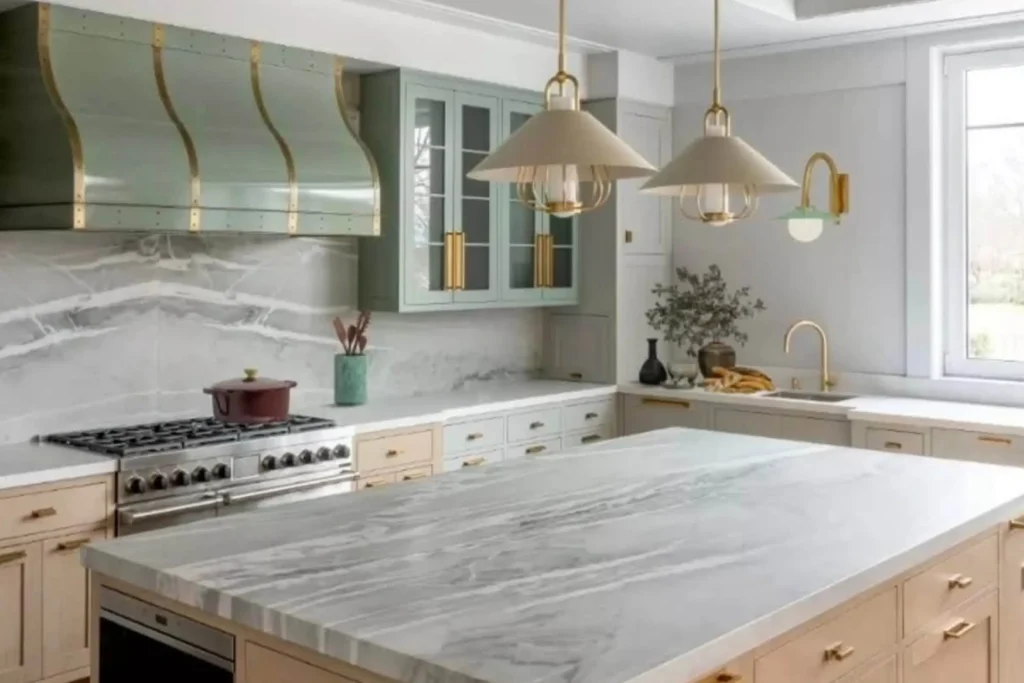
Custom Range Hoods
There’s an easy calculation to help figure out the height a hood needs to be, even under a sloped or vaulted ceiling. Take the ceiling height and factor in the countertop height, with the standard in the industry being 36 inches. A hood should sit at least 36 inches off the cooktop surface or countertop, so taking ceiling height minus 72 inches gives the optimal height for a big custom range hood, with a vaulted ceiling often allowing for the tallest, most dramatic versions of this math.
Hoods Designed to Sit Higher Under Vaulted Ceilings
A flush ceiling-mounted hood is designed to go a lot higher than traditional hoods, which works especially well under a vaulted or sloped ceiling, so the view isn’t blocked by the hood itself.
Controlling a hood mounted that high under a vaulted ceiling isn’t a problem, since a remote can magnetically stick to any metal section of the kitchen or sit in a drawer, controlling the lights, the hood, and the timer.
A plastered hood is another example built with real grandeur in mind, taking advantage of really tall, vaulted ceilings to go higher with the size of the hood, framed out by a contractor and plastered over the face. It gives the kitchen a grand feeling, and the hood insert underneath stays hidden.
Custom Metal and Brass Hoods That Work Well Under Height
A finished metal hood with curvature and antique brass banding is something that can be done entirely in-house, customizing the color, the metal, and the rivets. The duct cover, the section that covers the circular ducting, is what determines the mounting height of the hood under a vaulted or sloped ceiling and the overall scale.
Blower Options for Larger Hoods Under High Ceilings
There are three major types of blowers for hoods, especially relevant for the bigger hoods that vaulted or sloped ceilings allow. An internal blower is mounted inside the hood itself, one of the most common styles. An inline blower sits in line with the ducting, somewhere in an attic space, in a soffit, or in cabinetry, depending on the ducting and hood situation.
A remote or external blower sits outside the home, usually between 20 and 24 inches by 24 inches, either rectangular or square, and visible if placed on a front wall, so it’s better placed up on the roof or the side of the house. The benefit of an external blower is less motor noise in the kitchen, though most of the noise realistically comes from air moving rapidly through the filters.
Duct Diameter Considerations for Bigger Hoods
Duct diameter is a huge thing to account for, especially when a vaulted or sloped ceiling allows for a larger, more powerful hood. An 8 inch round duct is a more standard size for something like a 36 inch hood, while a 48 inch or 60 inch hood range needs the duct diameter to get up to 10 inch or 12 inch round, sometimes transitioning two ducts into one.
Reducing from a 10-inch or 12-inch duct down to 8 inches is against code and won’t work, since that reduction acts basically as a wall and the hood won’t duct air outside properly.
Final Thoughts on Designing Your Hood
I hope you guys enjoyed this blog on how to design a custom range hood for vaulted and sloped ceilings. I know there’s a lot of information in there, but this is one of the focal points of the kitchen. So, you want to make sure that it’s perfect and that you can have a real centerpiece to your kitchen in the end.
If you’d like help designing your hood, whether it’s custom or standard, contact us, and we’d love to help you out with that.