
Custom range hood design starts by choosing the design style, or your preferred style of hood. That’s the most important thing. This is the focal point of your kitchen, so what you’re looking at should be something that you love and will cherish for years to come.
One of the most important things to determine: do you want a traditional hood, a transitional hood, or a contemporary modern hood? Different finishes and different colors are all possible. A hood can be a matte lacquer cabinet designed to match the cabinets of the island, or a plastered hood framed out by the contractor and then plastered over the face.
With really tall ceilings, you can go really high with the size of the hood, and it gives a grand feeling in the kitchen.
Know the Terminology
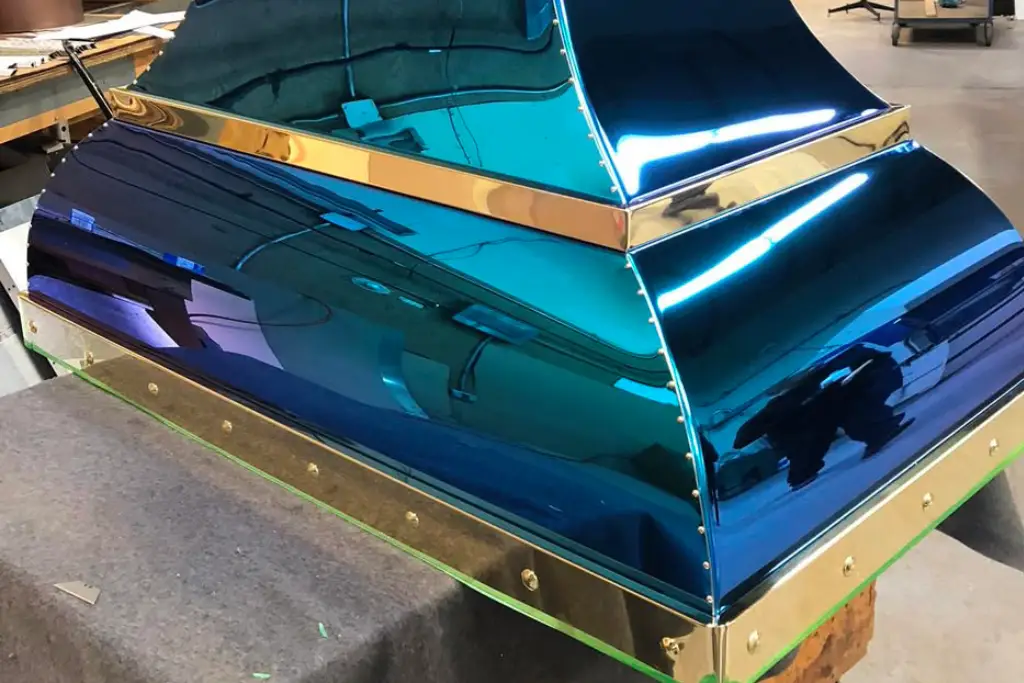
Custom Range Hood Design
On a finished metal custom hood, the parts are called banding, and the little dots are called rivets. Another term to know is duct cover, the section that literally covers the circular ducting. This is important because it determines the mounting height of your hood and the scale of your hood, so getting that right is extremely important.
Some hoods have a really short duct cover, only about a 3 to 4 inch duct cover; others are seamless, with no duct cover over the top. On a trapezoidal chateau-shaped hood, the section at the bottom is called the lip.
There are different lip treatments: you can raise the lip, make it flush with the body of the hood, put banding or rivets on it, or polish it.
Mounting Height and Ceiling Height
One of the most important parts of custom range hood design is the ceiling height, floor-to-ceiling height. This determines the scale and the size of your hood. A tall, big, expansive hood would not look the same on an 8-foot ceiling; it would look short and squatty. There’s a really easy calculation. Take your ceiling height and factor in your countertop height.
The standard in the industry is 36 inches for the countertop height. The hood should be at least 36 inches off the cooktop surface. So that’s 36 inches, another 36 inches, that’s 72 inches. Your ceiling height minus 72 inches is the optimal height for a big custom range hood. There are instances where the ceiling might not be tall enough, and that’s okay.
Blower Options
You do have options when it comes to your motor or blower. There are three major types. An internal blower is mounted inside the hood, and that’s one of the most common styles.
An inline blower is designed to go literally in line with your ducting; the motor sits between the hood and the discharge of the duct to the outside, so it can go in attic spaces or cabinetry, depending on your ducting situation.
Duct Diameter
This is a huge thing to take into account if you are not building from scratch or you’re remodeling. If you’re trying to retrofit or replace, you really need to figure out what your duct diameter is, because this determines how powerful a blower you can have.
An 8-inch round is a more standard size; a 36-inch hood might have that. When you get into a 48-inch or 60-inch range, the duct diameter starts getting up to 10-inch or 12-inch round, and sometimes you need to transition two ducts into one.
Filter Types
A steel mesh filter is removable inside your hood. You flip a little switch, and these are dishwasher safe, so wash them out every 3 months or so, depending on how often you cook. The most popular pro-style filter is a baffle filter.
The baffles are offset on each side, so the air to be sucked up has to come up, come down, and back around the baffle to go out; when that air turns like that, the heavy grease cannot make that turn, so it stays in the baffle filter. Another style is a no-baffle, no filter hood with a completely open canopy; the grease accumulates in a grease collection tray that you scrub out with some soapy water.
Microwave and Downdraft Options
An over-the-range microwave is a microwave and hood all-in-one. In small and limited spaces, it’s just so practical, but it doesn’t really capture grease as well as a traditional hood will, and it’s going to be super loud.
A downdraft hood is either a linear piece that raises up and down to create a draft that pulls the smoke down and out through the subfloor or cabinets, or a circular type that doesn’t raise and lower. These are functional if you really don’t have the space, room, budget, or desire to have a hood above your cooktop.
However, downdrafts are not as efficient at capturing grease as a traditional overhead vent, so the first recommendation is always to try and get an overhead vent first.
Frequently Asked Questions
Why is the hood considered the focal point of the kitchen?
This is the focal point of your kitchen. So, you want to make sure that what you’re looking at is something that you love and will cherish for years to come.
How often should you clean the filters?
These are dishwasher safe. So, you’re going to want to wash these out. They’re going to get really greasy. So, pop them in your dishwasher and clean them every 3 months or so.
Can you reduce your duct diameter for a more powerful hood?
You cannot reduce from 10 in or 12 in down to 8 in. It’s against code and even beyond that, it just won’t work.
Are downdraft hoods as effective as overhead hoods?
Downdrafts are not as efficient at capturing grease and filtering it out as a traditional overhead vent is.
What causes the noise in a range hood?
Realistically, the bulk of the noise will come from the air moving through your filters.
Bringing It All Together
There’s a lot of information in there, but the custom range hood design is one of the focal points of the kitchen. So, you want to make sure that it’s perfect, and you can have a real centerpiece to your kitchen in the end.