
CFM shows up on every range hood listing, and most people picking out a new hood have no clue what that number should actually be. They’re comparing models based on how they look or whether it’s on sale, maybe glancing at the CFM and shrugging because 600 seems like more than 400, so it’s probably better.
Then they install it and six months later, their kitchen cabinets have this greasy film that won’t come off. Or they went too big and the thing sounds like a jet engine every time they turn it on.
CFM is cubic feet per minute. It’s measuring how much air the hood moves. A 500 CFM hood pulls 500 cubic feet of air through it every minute when it’s running full blast. The tricky part is figuring out how much you actually need for your kitchen, because it’s not the same for everyone, even if you have the same stove.
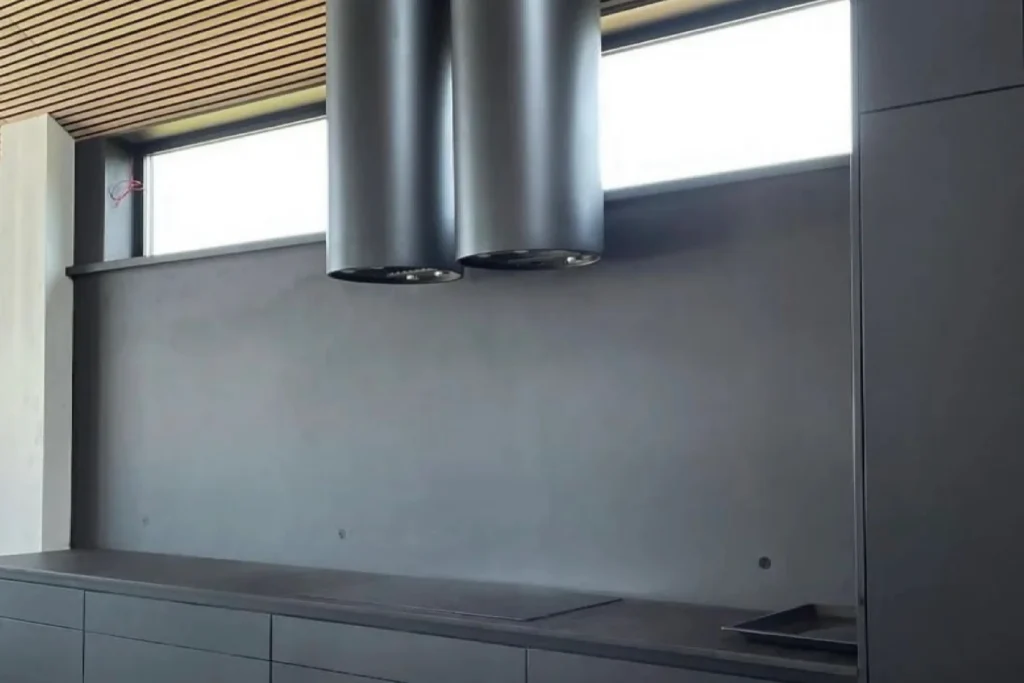
Range Hood CFM For Your Kitchen Size
What Happens When You Get It Wrong
I’ve been in plenty of kitchens where the ventilation just doesn’t cut it. The owners cook regularly, and you can tell – there’s this sticky residue on the upper cabinets near the range. The ceiling above the stove has a yellowish tint that wasn’t there when they moved in. They’re wiping everything down constantly and it still feels greasy.
That’s undersized ventilation. The hood runs, it makes noise, but it’s not actually moving enough air to pull out all the grease and smoke before it settles on surfaces. It’s not dramatic at first. You cook dinner, seems fine, maybe a little smoky, but you open a window. A month later, you notice the cabinets feel weird. Three months in and you’re scrubbing everything, wondering what happened.
Going way too big creates different problems, though it’s less common. Really high CFM hoods in regular residential settings can create negative pressure issues if the house is sealed up tight. Your furnace starts acting weird, doors become hard to open, and you might get backdrafting from your water heater. It’s rare with normal residential range hoods, but I’ve seen it happen when people install commercial units meant for restaurants in their regular suburban kitchen.
Range Craft Manufacturing talks to homeowners about this constantly. The first question is always “how do you cook?” Because someone making eggs for breakfast and heating up leftovers doesn’t need what someone who pan-sears steaks three times a week needs. The cooking matters as much as the stove BTUs.
Starting With the Basic Calculation
For gas ranges, the formula is simple enough. Take your total BTU output and divide by 100. That gives you the minimum CFM. So a 40,000 BTU range needs at least 400 CFM to handle it properly. It’s not perfect but it gets you in the ballpark.
Electric cooktops work differently. You go with 100 CFM per linear foot of cooktop. A 30-inch cooktop is 2.5 feet, so 250 CFM minimum. A 36-inch bumps up to 300 CFM.
Here’s the thing, though – those numbers are minimums under perfect conditions. Most kitchens should go higher than the bare minimum, especially if you’re cooking every day or doing anything that generates real smoke.
Why Your Kitchen Is Different
Perfect conditions basically never exist. Your ductwork isn’t short and straight. Your ceilings might be higher than standard. You might cook differently than whoever came up with these formulas assumes.
The way you cook changes everything. I know people with 30,000 BTU ranges who need more ventilation than the formula suggests because they’re searing meat at high heat constantly. I also know people with 50,000 BTU professional ranges who barely need ventilation because they mostly bake and simmer things.
Professional ranges are their own category. Anything above 50,000 BTUs needs serious CFM, usually 600 to 800 minimum. These put out restaurant-level heat. I’ve seen people buy gorgeous 60,000 BTU ranges and pair them with 400 CFM hoods because nobody explained the requirements. They end up cooking with windows open year-round and the hood running constantly, still dealing with smoke.
The Ductwork Problem Nobody Mentions
CFM ratings assume ideal conditions – short, straight duct runs with minimal resistance. Real houses don’t look like that.
Your ductwork probably goes up through the ceiling, makes a couple of turns, runs across the attic, and exits through the roof 20 feet away. Every turn costs you airflow. Every foot of duct creates friction. A 500 CFM hood with complicated ductwork might only effectively move 350 CFM by the time you account for all the losses.
This is why people with long or complicated duct runs need to oversize their hoods compared to the basic calculation. You’re compensating for what you lose in the ducts. If you’ve got 25 feet of ductwork with three elbows, add 25-30% to your calculated CFM requirement. Otherwise you’ll be undersized when it matters.
Ductless hoods that recirculate air back into the kitchen can’t remove heat or moisture, only filter grease and odors. They work okay in apartments where venting outside isn’t possible, but they’re not as effective as proper vented kitchen ventilation. If you’re stuck going ductless, bump up your CFM beyond what you’d need with a ducted setup.
Kitchen Size and Ceiling Height
A small galley kitchen with 8-foot ceilings has maybe 600 cubic feet of air total. A big open kitchen with 10-foot ceilings connected to the living room has thousands of cubic feet. The same 400 CFM hood performs very differently in those spaces.
Bigger kitchens with high ceilings need more CFM for adequate air turnover. If your kitchen is over 200 square feet or ceilings are above 9 feet, add 10-15% to whatever the formula tells you. It’s not an exact science, but it accounts for the extra volume.
Mounting height matters too. Standard is 24 to 30 inches above a gas cooktop, 20 to 24 for electric. That’s based on optimal capture – close enough to catch smoke and grease, far enough to not be in your way while cooking.
Sometimes you need to mount higher. Maybe you’re tall and standard height puts the hood right in your face. Maybe there’s a pot filler that interferes. Whatever the reason, mounting higher reduces how well the hood captures what you’re cooking. Air spreads as it rises, so the hood has to work harder. Higher mounting needs higher CFM to compensate, maybe 10-20% more, depending on how far above standard you go.
Island Installations Need More Power
Wall-mounted hoods have a major advantage. The wall contains the air and helps direct it into the hood. Islands don’t have that. Air currents come from every direction; there’s no wall to help, just open space.
Island range hoods need substantially more CFM than wall units. The standard recommendation is 50% more. If you’d use 400 CFM on a wall, you need 600 CFM on an island. I’ve had people argue with me on this, saying it seems excessive. Then they live with an undersized island hood for a month and call back wanting to upgrade because smoke escapes around the edges constantly.
Range Craft Manufacturing makes american made range hoods designed specifically for islands. They’re wider for better coverage, higher CFM, different blower setup optimized for pulling air from all directions. It’s actual engineering for the application, not just sticking the same wall unit over an island and hoping it works.
Nobody Talks About Noise Until It’s Too Late
High CFM can mean high noise. People don’t think about this until they’ve installed an 800 CFM hood and realized it sounds like they’re standing next to a highway when it’s on full blast.
Range hood noise gets measured in sones. Higher numbers mean louder. Most residential hoods run 4 to 8 sones at max speed, which is noticeable but manageable. Commercial-style hoods can hit 10 or 12 sones, which is genuinely loud – you’re shouting to have a conversation.
Variable speed controls help a lot here. Run low or medium for normal cooking, save high speed for when you’re actually generating serious smoke. A properly sized hood at medium speed often moves plenty of air for everyday cooking without being annoying.
Build quality affects noise, too. A well-made custom range hood with a decent blower runs quieter than a cheap unit maxed out trying to move the same air volume. Range Craft Manufacturing pays attention to this because nobody wants their ventilation dominating the sound in their kitchen every time they cook.
What the Numbers Look Like in Real Kitchens
Standard 30-inch gas range putting out 30,000 to 40,000 BTUs works with 400 to 500 CFM wall-mounted, 600 to 750 CFM on an island. That handles typical home cooking with room to spare when you need it.
Professional-style 36-inch range at 60,000 BTUs needs 600 to 700 CFM minimum on a wall, 900 to 1000 CFM on an island. You’re dealing with serious heat output; you need serious ventilation to match.
A standard 30-inch electric cooktop does fine with 300 to 400 CFM on a wall, 450 to 600 CFM on an island. Electric is more forgiving than gas on ventilation requirements.
These aren’t rigid rules. They’re realistic ranges that work in most situations. Your specific kitchen might need adjustments based on ductwork, how you cook, and ceiling height, all the factors we’ve covered.
Making the Decision
Once you’ve calculated what you need and adjusted for your situation, think about how you’ll use the kitchen over time. Good range hoods last 15 to 20 years. You don’t want to fight inadequate ventilation for two decades because you went minimal to save $200 upfront.
When you’re between two CFM options, going higher usually makes sense. You get flexibility and you can handle those times when you’re cooking something that generates way more smoke than usual. You can run a powerful hood at lower speeds. You can’t make an underpowered hood move more air when you need it – it is what it is.
Range Craft Manufacturing works through these specs all the time with homeowners and contractors. Getting the CFM right from the start means your American-made range hood actually does its job – pulling out heat, smoke, and grease without being the loudest appliance in your house.
A quality custom range hood is a real investment. Taking time to calculate the right CFM for how you cook and your specific installation means that the investment performs the way you need it to for years.
The difference between adequate and inadequate ventilation shows up constantly. Better air quality. A kitchen that doesn’t smell like fish for three days after you cook salmon. Cabinets that stay clean instead of developing greasy film you can’t get off. Ceiling that stays its original color instead of yellowing above the range. This stuff matters when you’re living with it every day.
If you’re dealing with anything complicated – long ductwork runs, island mounting, high-BTU professional range – talk to someone who specs these systems regularly instead of guessing. Getting it right the first time beats realizing months later that your ventilation can’t handle how you actually cook.